


In Conversation with Dr. Basana Gowda G: NAAS Associate 2025
by Arindam Kumar
Dr. Basana Gowda G., currently serves as Senior Scientist (Entomology) at ICAR–National Research Centre on Pomegranate, Solapur, Maharashtra. Hailing from Nidigol village in Sindhanur Taluk, Raichur district of Karnataka, his journey exemplifies how dedication and scientific curiosity can lead to national recognition.
An alumnus of the University of Agricultural Sciences (UAS), Dharwad, Dr. Gowda completed his postgraduate and doctoral studies at UAS, GKVK, Bengaluru, where his academic foundation in entomology took firm shape. He joined the Agricultural Research Service (ARS) in 2015 and, began his professional career at the ICAR–National Rice Research Institute, Cuttack, Odisha. Following his selection as Senior Scientist through Direct Recruitment, he has recently been assumed his current position at ICAR-NRC on Pomegranate, Solapur.
Dr. Gowda’s research excellence is reflected in his impressive scholarly output of over 60 research publications in reputed national and international journals, gaining more than 1,865 citations, with an h-index of 19 and an i10-index of 31. His work has earned him numerous accolades, most notably the prestigious NAAS Associateship 2025, conferred by the National Academy of Agricultural Sciences, New Delhi.
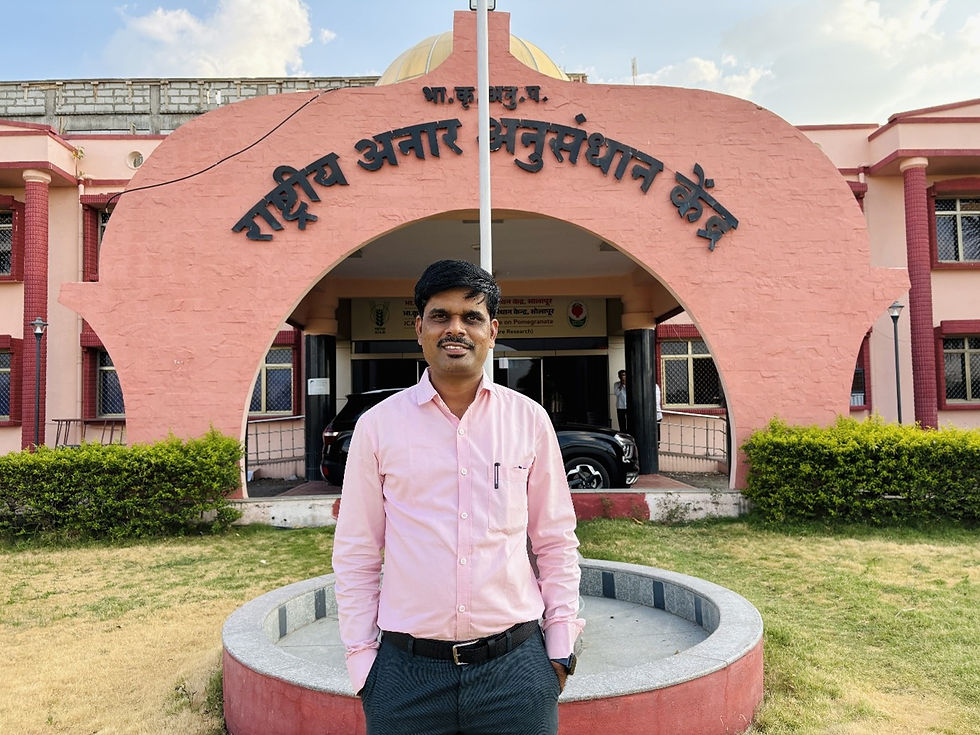
Widely recognized as a leading young scientist in entomology, Dr. Gowda’s contributions have been acknowledged by several national and international organizations. The Indian Entomologist is proud to feature his inspiring journey. Our conversation with Dr. Gowda was both insightful and motivating, and we are confident that his story will resonate deeply with students, researchers, and early-career scientists.
AK (Arindam Kumar): What aspects of your childhood shaped who you are today, both personally and professionally?
BG (Basana Gowda G): I was born and brought up in a small village called Nidigol in Sindhanur Taluk of Raichur district, Karnataka. My father is a farmer and my mother is a homemaker. I completed my schooling (Class 1 to 10) in my native village in Kannada medium, which deeply connected me to rural life and its realities. Until I completed my pre-university education at Vijayanagar College, Hospet, I had never even heard of a course called B.Sc. (Agriculture). Although I had secured a decent rank to pursue engineering, but I opted for agriculture mainly because of the lower course fee and the availability of an education loan. That decision, driven by circumstance, became a turning point in my life and shaped me into what I am today both personally and professionally.
AK: What initially drew you towards the field of agricultural entomology, and how did your journey unfold into a specialization in rice crop protection and pest management?
BG: Well, my interest in Agricultural Entomology was sparked during my undergraduate studies at the University of Agricultural Sciences (UAS), Dharwad, Karnataka. The way entomology was taught there, with excellent faculty, laboratories and a strong focus on field demonstrations, captured my curiosity, which eventually led me to pursue a career in Entomology.
Coming from a rice-growing family, I developed a natural affinity for crop cultivation early on. However, my journey into crop protection truly began when I joined B.Sc. (Agriculture). During those formative years, I began supporting farmers in my village with whatever knowledge I was gaining at college, particularly on pest and disease management. Incidentally, after joining ICAR as a Scientist (Entomology), I was posted at the ICAR-Central Rice Research Institute (formerly NRRI), Cuttack, Odisha. I considered it both a privilege and an opportunity, felt like a natural extension of my roots and interests. At CRRI, I had the privilege to work closely on biological control, insecticide hormesis, and integrated pest management strategies specific to rice with wonderful team.
AK: Growing up or during your early academic years, were there any mentors or experiences that significantly influenced your decision to pursue research in crop protection?
BG: During my early academic journey, I had the privilege of being guided by several inspiring teachers and seniors who helped me to transform Entomology from just a subject into a meaningful pursuit. One of the most influential figures was Dr. R. K. Patil, the then Professor of Entomology, who taught two key courses during my B.Sc. Agriculture. His strong emphasis on practical, low-cost, and farmer-oriented pest management approaches left a lasting impression on me. His field-centric teaching and practicals deeply resonated with my aspirations. Moreover, witnessing the impact of pest outbreaks like brown planthopper (BPH) and blast disease on rice crop in my village instilled in me a deep sense of responsibility. These experiences collectively shaped my determination to pursue research in crop protection.
AK: Your work focuses deeply on biological control of pests. Could you share how you evaluate the field performance of bioagents in rice ecosystems, and what factors determine their success or failure?
BG: To me, rice has never been just a crop. It’s an ecosystem, where every insect pest, natural enemies (predator, parasitoid and pathogen) and environmental factor plays a key role. Moreover, I come from a region (Sindhanur, Raichur, Karnataka) known for high pesticide use in rice. From childhood, I witnessed the over-reliance on chemical pesticides in my village. These early observations left an impression on me and sparked an interest in finding safer, more sustainable pest management strategies. This background, combined with my academic training, shaped me to promote biological control.
Biocontrol is not new; it is one of the oldest forms of pest management, practiced long before synthetic pesticides were introduced. Hence, many times we take biocontrol agents for granted, expecting consistent results without fully addressing the ecological and biological factors that influence their performance. One critical factor often overlooked is the quality and suitability of the host or prey used for mass multiplication of parasitoids and predators. Using suboptimal hosts can lead to weak or behaviourally compromised bioagents, reducing their effectiveness in the field. In addition, external factors such as pesticide exposure at lethal and sublethal concentrations, release timing, climatic conditions, etc. further affect their survival and performance. Failures in biocontrol are often not due to the concept itself, but due to gaps in understanding and implementation.
The availability of bioagents has emerged as one of the major constraints in implementing biological control strategies at scale. To address this challenge and ensure consistent regional supply, we adopted an entrepreneurship-driven model, engaging local youth and agripreneurs to establish decentralized bioagent production units.
AK: Incorporating drone technology for pesticide application is an innovative step. How did this idea develop in your research, and what have been your key takeaways about its feasibility and farmer acceptance?
BG: Incorporating drone technology for pesticide application emerged as a response to several challenges in rice cultivation. Rice, being one of the most pesticide-intensive crops, especially in high-input production systems, poses unique difficulties for plant protection. The wetland ecosystem of paddy fields makes manual spraying not only laborious and time-consuming but also physically demanding and hazardous for farm workers. Moreover, rice farmers often incur significant expenditure on labour for spraying operations, especially during peak pest outbreaks.
This led us to explore drone-based pesticide delivery as a potential solution. We were among the earliest research teams in India to work on drone technology in agriculture at a time when even conducting R&D trials required special permissions from the Directorate General of Civil Aviation (DGCA) and the Ministry of Civil Aviation (MoCA). Navigating these regulatory processes, especially during Covid-19 pandemic was itself a great learning for us and reinforced our commitment to drone research. Later, I also became a certified drone pilot, which enabled us to conduct operations more professionally and in compliance with regulatory norms.
Our field-level experience has yielded encouraging insights. Drones have proven effective in reducing labour dependency, minimizing operator exposure to agrochemicals, and ensuring precise, timely application even in difficult to access areas. Although there is a prevailing perception that drones are unsuitable for small and fragmented landholdings, our assessments indicate the opposite. Given the current battery capacity and spray efficiency, drones are particularly well-suited for smallholdings. They successfully address a critical technological gap in regions where large contiguous farms are uncommon and conventional aerial spraying using helicopters or planes are either impractical or economically non-viable.
However, certain challenges do persist. High initial investment costs and the need for skilled operators continue to be barriers to its widespread adoption. Encouragingly, several drone manufacturers and agrochemical companies have begun offering drone-based spraying services at costs roughly equivalent to the wage of one farm labourer per acre. With sustained government support and policy incentives, drones are poised to become as common place and accessible as other agricultural implements shortly.
AK: Have there been any memorable on-ground experiences with farmers or extension teams that have shaped or shifted the direction of your research over the years?
BG: During several field visits and training programmes across Odisha during initial years of my joining, especially in tribal belts, we observed that farmers in these regions showed little inclination toward chemical pesticides and were instead interested in natural and low-cost pest control methods. This feedback was eye-opening for us. Limited availability of quality biocontrol agents is biggest concern even today, and moreover macrobial production units in India are functioning mostly under public sector organizations, which could not fully meet the rising demand, especially in remote areas. Through deeper engagement, we also understood why private players had not ventured into this space, mainly due to high production costs, labour-intensive processes, and narrow profit margins discouraged their investment. Motivated by these insights, we conceptualized and submitted a project proposal to RKVY, Odisha which was subsequently sanctioned (~4 crores).
Under this project, we concentrated on designing a cost-effective and less labour-intensive model for biocontrol agent production. Through the automation of approximately ~30% of the production process, we were able to substantially cut down on manual labour and operational expenses. As part of our efforts to automate the production system, one of our innovations ‘efficient and portable insect collector with automated counter’ has been granted with Indian patent. To enhance the fitness and performance of biocontrol agent organisms, we explored the concept of insecticide-induced hormesis, a phenomenon where sublethal concentration of insecticides stimulate physiological or behavioural benefits.
To ensure last-mile delivery of biocontrol solutions, we developed five dedicated entrepreneurs exclusively engaged in the large-scale production of biocontrol agents. This decentralized model would significantly bridge the gap between supply and demand, while simultaneously promoting rural entrepreneurship and accelerating the adoption of sustainable pest management practices among farmers.
AK: From your experience, what role should policymakers play in promoting the adoption of eco-friendly and integrated pest management practices across regions like eastern India?
BG: Policymakers play a vital role in advancing eco-friendly and integrated pest management (IPM), particularly in regions like eastern India where smallholder farming dominate. There is a pressing need to support decentralized bioagent production through entrepreneurship and replicate models like ours. Additionally, policy incentives for biological and botanical alternatives alongside conventional input subsidies can accelerate adoption. Strengthening extension systems to enhance farmer capacity will further ensure that sustainable pest management becomes both accessible and scalable across diverse agro-ecosystems.
AK: You’ve seen agricultural entomology evolve over the years. How has the discipline changed, and what excites you most about its future potential—particularly in rice-based systems?
BG: Agricultural entomology has evolved from a largely reactive, pesticide-driven approach to a more holistic, systems-based science that integrates ecology, insect behaviour, and emerging technologies. In rice-based systems, we have shifted from simply managing insect pests to understanding their complex interactions within the agroecosystem, considering factors like climate variability, natural enemies, and crop phenology. What excites me most is the integration of precision tools such as drones, remote sensing, and AI-driven pest forecasting, which are revolutionizing real-time pest monitoring and management. This transition toward data-informed, ecologically sound practices holds tremendous potential. Ultimately, the true success of these advancements lies in ensuring they effectively reach and benefit farmers on the ground
AK: Outside the lab and fieldwork, what keeps you inspired and grounded in your journey as a scientist? Are there books, hobbies, or values that have influenced your approach to research and leadership?
BG: I don’t always think in grand terms, but I prefer to start small. Often, we all held back by imagined problems and a desire for perfection. But I believe in beginning because once you start, the journey itself becomes the guide. I find joy in step-by-step progress and small accomplishments, which bring a sense of satisfaction and motivate me to keep moving forward. I am also a little curious about cross-boundary happenings, whether from business, industry, or other disciplines and contemplate how such ideas can supplement or complement our field of research. A team is absolutely vital especially a multidisciplinary one, supported by dedicated lab staff who can move heaven and earth. Success isn’t a solo journey; it’s about taking people along and growing together. I am not a voracious reader; I only read occasionally. But when I do, I focus on what truly interests or adds value to my work and thinking.
Despite all the advances we speak of in science and technology, the farmer on the ground is still striving for the basics. This reality grounds me and reinforces the need for practical, accessible innovations that truly reach and benefit those at the last mile. Simplicity, persistence, and empathy are the values that guide both my scientific thinking and leadership. Regarding hobby, daily walks have become a simple yet powerful hobby in my life, enhancing my observation skills, and offering quiet moments of connection with nature and my thoughts.
AK: As someone who has contributed significantly to pest management research, what message would you give to young students and scholars aspiring to build a career in entomology and sustainable agriculture?
BG: I am still learning myself, so I wouldn’t call this a message, just a few suggestions from my little experience so far. Entomology opens a fascinating world where tiny insects have a massive impact on our food, health and environment. If you're pursuing a career in entomology, I would suggest being open to nature and staying connected to the ground realities. While advanced academic research is important, it’s equally vital to understand what farmers truly need. Be open to learn from different arenas like business, technology etc., and think about how those ideas can be adapted to your research. Small, yet practical innovations often create the biggest impact when they are rooted in local needs. Keep your curiosity alive and stay close to the field, that’s where the real learning happens.
AK: Finally, what does success mean to you—as a scientist and mentor?
BG: To me, success isn’t the absence of failure, but the ability to turn failures inside out, learning from them, reshaping them and building something better. As a scientist, whether it’s a failed experiment or a field trial that didn’t meet expectations, each challenge becomes a lesson for a better tomorrow.
As a mentor, success means bridging the academic gaps we once faced ourselves. I strive to nurture the questions we never asked, the skills we lacked, and the critical thinking that wasn’t fully developed. By helping students grasp what we didn’t learn properly, I not only support their growth but also continue my own. My goal is to guide them toward becoming independent thinkers and researchers who can question deeply, design effectively, and lead confidently. When they take ownership of their learning, that’s true mentorship success.
AK: To whom do you dedicate the NAAS Associateship 2025?
BG: I dedicate the NAAS Associateship 2025 to my parents, family whose sacrifices and unwavering support have been the backbone of my journey. I also dedicate this honour to my mentors, colleagues, staff and students, whose guidance and support have played a vital role in shaping my professional path. I thank NAAS, New Delhi for bestowing me with this prestigious award and for recognizing my contributions to agricultural Entomology.
Finally, I extend my heartfelt thanks to Indian Entomologist for this interview. My best wishes to the team for their continued efforts in promoting and strengthening the discipline of Entomology.
About the author:
Arindam Kumar, PhD Research Scholar, Division of Crop Protection, ICAR-Indian Institute of Horticultural Research
Email: arindamkumar2020@gmail.com
Disclaimer: The contents, style, language, plagiarism, references, mention of any products if any, etc., are the sole responsibility of the author


Dear Dr. Basana-Gowda G,
Heartiest congratulations on receiving the prestigious NAAS Associate Award! 🎉
It has been a privilege to work alongside you for the past 10 years and witness your dedication, perseverance, and remarkable contributions to agricultural field, particularly on Entomological science. This recognition is a true reflection of your hard work and commitment to excellence.
I am proud to call you my colleague and friend, and I look forward to seeing your continued success and impact in the years ahead.
With best wishes,
Guru-Pirasanna-Pandi G